
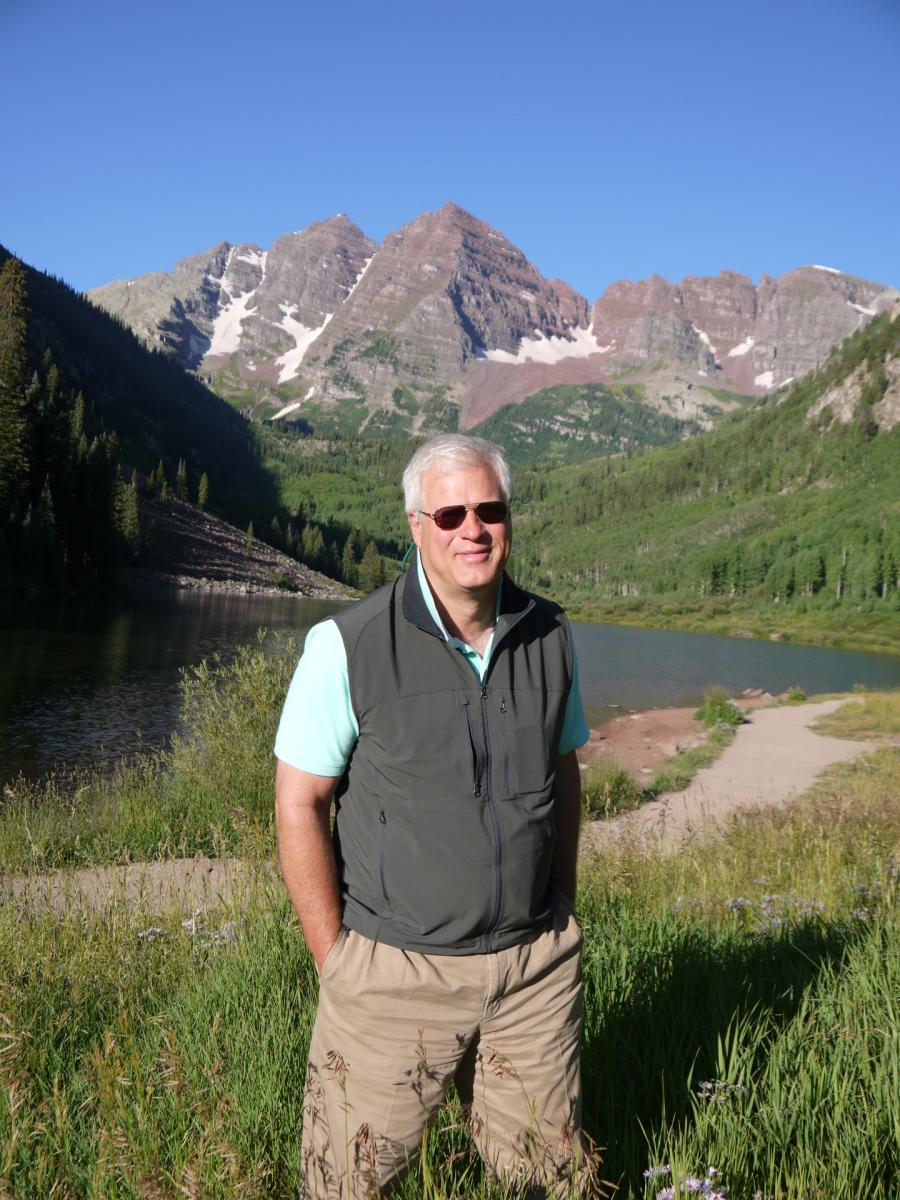
Dr. F. Richard Hauer (September 23, 1950 – October 29, 2025)
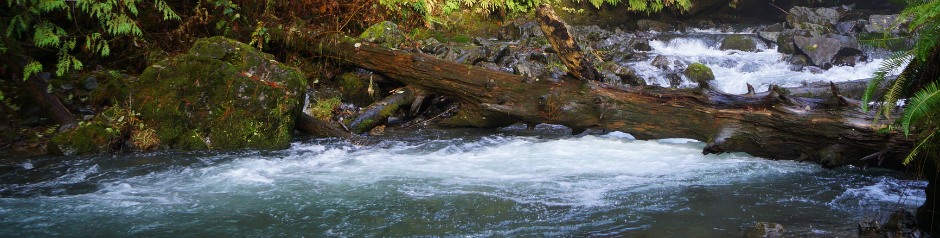
“Eventually, all things merge into one, and a river runs through it.” (Norman Maclean)
If ever a quotation described a person, the one above describes the life and loves of Dr. F. Richard (“Ric”) Hauer, who passed away peacefully on October 29, 2025, surrounded by his loving family. Ric’s bloodstream was infused with river water and his persona exemplified the simple yet elegant principle of tributaries merging to form a mountain river. Ric’s love of streams and rivers, especially those of the northern Rocky Mountains where he spent most of his career, was deep and broad like the gravel-bed floodplain rivers he most cherished. Ric’s legacy is one of deep commitment to the many people he touched during his full life and an unwavering purpose to study and preserve the flowing waters we all cherish.
A native of rural Michigan, Ric obtained his B.S. and M.S. from Michigan State University in Fisheries Science. In the late 1970s, Ric earned his Ph.D. working with his life-long friend Dr. Jack Stanford at the Flathead Lake Biological Station of the University of Montana (UM), where Ric played a lead role in long-term studies of river ecology in the Flathead River-Lake Ecosystem. His devotion to the Biological Station and the science of stream ecology continued throughout his 50-year career. He was a UM Distinguished Scholar and a Fellow and past president of the Society for Freshwater Science, among many other professional recognitions. Ric had a passion for mentoring students and colleagues, often focused on field experiences, including treks into the backcountry of Glacier National Park and surrounding wilderness areas. He was much loved for both his devotion to his family and his leadership in river science. Ric also had a unique talent for scientific synthesis – bringing experts together to examine and summarize key aspects of freshwater science and conservation that propelled the discipline forward.
Ric’s deep understanding of river systems, fueled by his love of the field, made him an excellent teacher and mentor. His teaching abilities inspired everyone, from graduate students to local citizens. At the core, he successfully conveyed to his students how the river operates as a system. That knowledge took on a life of its own, guiding college students to their careers, decision-makers to halt coal mining in the upper Flathead system, lawyers to prevent effluents from entering Flathead Lake, and hundreds of US Army Corps of Engineers employees to improve their management of rivers. Just a few months back, his colleague Bill Kleindl recounts that Ric was standing in front of 30 students from the Army Corps and stated, “I am sure that you, like me, fell in love with rivers as a child. Playing in the currents, flipping rocks to look for bugs, and catching fish. How great is it that we get to spend our whole lives playing in rivers?” The students nodded and smiled. Ric was correct; the river life is a great life, made better by his ability to share his knowledge.
Ric was an educator and mentor to many. During his years at the Biological Station, he helped create the context for extraordinary hands-on, “in-the-water” learning for the numerous students who took his summer stream ecology course. He led field excursions that became unforgettable, transformative experiences. Students recall the real joy he conveyed in turning over a river rock to point out the many macroinvertebrates to be found, especially the net-spinning caddisflies that were a passion of Ric’s throughout his career. He was also a mentor to many graduate students, creating opportunities and training for these individuals that set the stage for their own careers in freshwater science. His student advisees pursued projects marked by intensive field work, ranging from alpine streams to floodplain rivers to wetlands. Ric introduced these students to the entire process of research, from the rigors of field work to the opportunities and challenges associated with collaboration and publishing, and there were many lessons learned. Moreover, Ric played a crucial role in connecting his students to the broader, extended family of freshwater scientists. One of the key ways he did this was by involving them in meetings of the Society for Freshwater Science, by which many of them (for example, his MSc advisee Colden Baxter, who went on to serve as an SFS president) “found their people” and established rich personal and professional relationships. For these and the many other opportunities Ric helped create, his students are deeply grateful.
Ric’s friends and colleagues recognize the privilege of having known him, and universally refer to him as being kind and compassionate, intelligent and creative, a great listener and storyteller, and deeply committed to education and conservation. Ric’s colleague Mark Rains recounts that “Ric treated us all in the same manner on the first day we met him as on the last day we saw him, as trusted friends and valued colleagues he was privileged to have in his life”. Some part of Ric never really “grew up”, and he retained to the last an almost youthful sense of wonder in the world and openly cherished our opportunity to be a part of it. He loved to wander the riverscape with his friends and colleagues, from the main channel to the natural levees and crevasse splays, to the sloughs and springbrooks, to the broad expanses of the floodplain, seeing the predictable patterns in the vegetation, their downed biomass making its way into the soils and flowing waters, alongside the many species of fungi and invertebrates, amphibians and reptiles, birds and mammals, all interlaced into the symphony of life. Those of us who had the good fortune to accompany him on these forays are forever changed for the better.
Ric leaves behind his spouse, Brenda, of 54 years, their children Andrew and Bethany, and seven grandchildren – all of whom he adored. Ric cherished his family and took every opportunity to spend time with them – be it at their sporting events, music recitals, Sunday family dinners, camping trips, or floats on the river. Aside from being an excellent scientist, Ric will be remembered as a devoted husband, father, and grandfather and a loyal friend to all those who had the privilege to know and love him. Our world is diminished by his passing, but the Lord will learn a lot more about rivers.
- Gary Lamberti, Jack Stanford, Bill Kleindl, Mark Rains, and Colden Baxter